
Forum on Systems Medicine and Pharmacy
- Artificial Intelligence and Synthetic Biology
The Evolutionary Path of Medicine 
Humanity - survival in the universe, from Noah's Ark on Earth to interstellar spacecraft, the breakthrough of development bottlenecks, not only in robotics and energy technology, but especially in artificial intelligence and synthetic biotechnology.
From critical thinking and discernment to the controlled experimental method - a-the authentic investigation of historical origins, b-the factual verification of academic theories, and c- pursuit of excellence in artisanal techniques, forming innovation-driven economic growth.
The combination of quantitative models and observational operations, from empirical to practical implementation, constitutes the engineering model for industrial transformation.
 -
-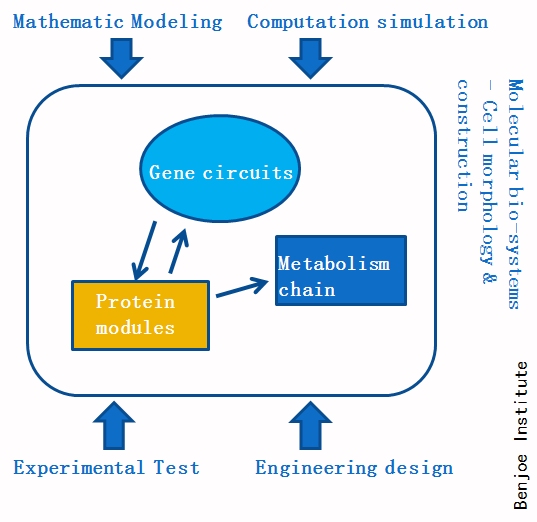
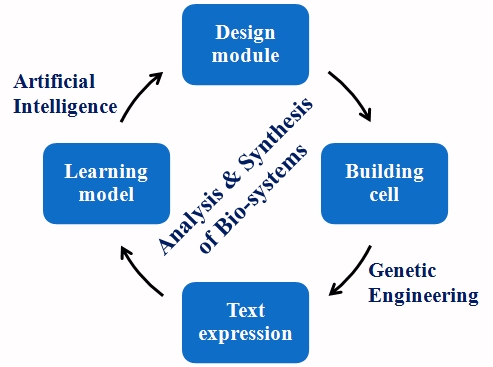
Biofoundry technology platform - cells manufacturing, automated laboratory and standardized industrial processe:
Upstream - gene and molecular modules, Midstream - engineered cell design and synthesis of sensors and reactors - DBTL learning-design-build-test cycle mode, Downstream - fermentation and product refining.
Creative culture and visual arts studio - Advertising planning and packaging design, the oriental artistic style.
From C. Bernard's 1-Experimental Medicine and Crick's 2-Central Dogma to 3-Cytohistogenesis - Bj.Zeng's Exploration:
In 1986, moving towards neurogenetics, and subsequently, complex systems and medical theory - network topological models and neurocybernetics.
From 1991 to 1999, bioelectronic technology integrating artificial intelligence and genetic engineering*, systems medicine - systems genetics and bioengineering - the analog coupling mode of systems and synthetic biology, and develop the design of nanomachines integrating cell bionic engineering and transgenic tecchnology.
2007-2010, Dynamics of cytogenesis - neuron computers and organic robots.
And by 2023 - synthetic neurogenetics, future AI directions - neuronal quantum computers.
Note* - Systematic Methodology:
1994-1996, Central Laboratory, Institute of Microbiology, Chinese Academy of Sciences - DNA sequencing and synthesis - Protein sequencing and peptide synthesis - mRNA differential expression analysis - Bioinformatics database retrieval.
From 1996 to 1999, organized international conferences and established the association - elaborating on bio-systems theory and the engineering design of artificial bio-systems, computational bioinformatics and experimental biotechnology.
After 2014, internationally, the method extended - DBTL cycle model.
Appendix - International Scientific Community:
Related literature index - 10(n) magnitude in authoritative databases, such as in June 2026:
1-Discipline, systems medicine - n=6, systems biological engineering - n=5.
2-Discovery, artemisinin - n=4, regulatory T cells and Foxp3 - n=4, cyclicGMP-AMP synthase - n=3, Necrostatin-1 - n=2.
3-Invention, neuron computer - n=4, transgenic oviduct - n=2, etc..